Published article
How to Open the Door When It Is Locked
How to open the door when it is locked: safe first checks, when to stop, and how to call The LOCK Shop in Mesa at (480) 452-4505.
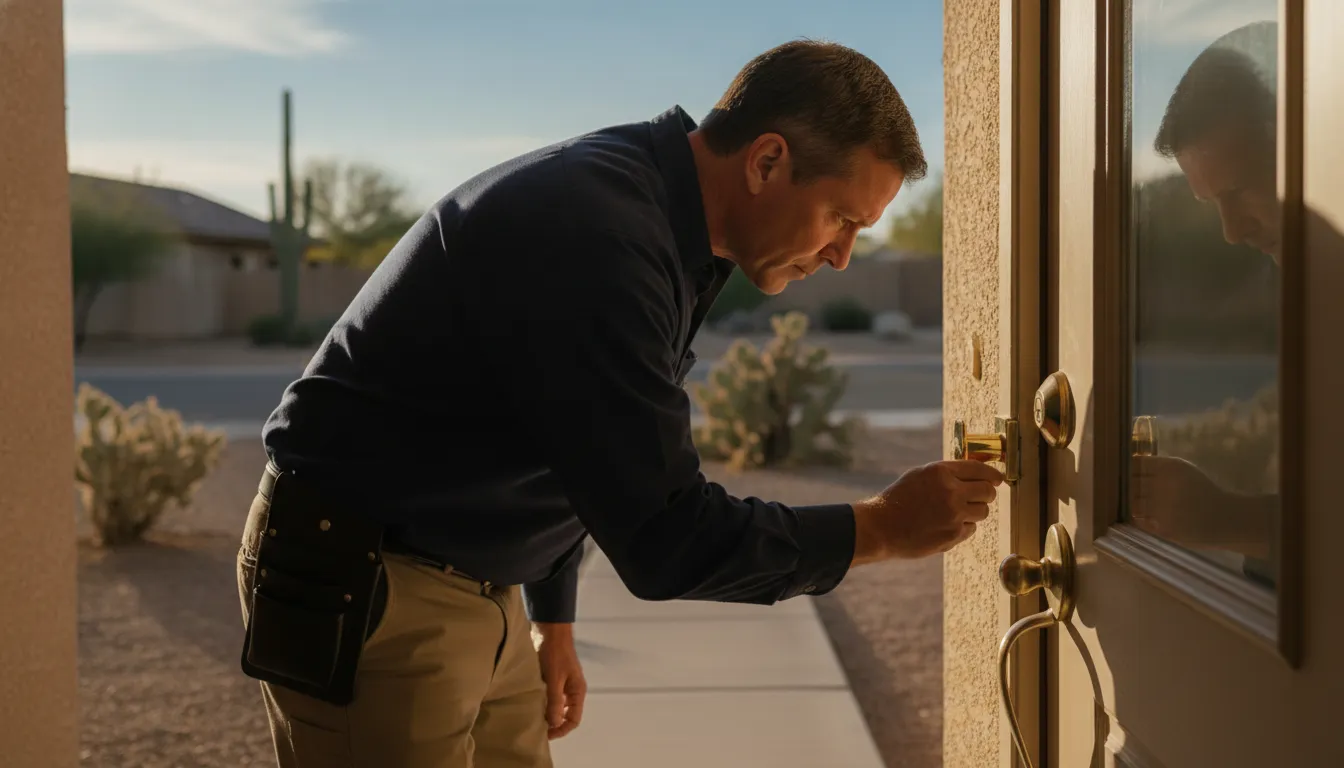
If you need to know how to open the door when it is locked, start with the safest checks, not force. Confirm which door it is, whether a key is on the other side, and whether the door is truly locked or only stuck. Then stop before you bend a key, pry the frame, or drill the lock. The LOCK Shop is a family-owned Mesa locksmith at 1155 South Power Road, Suite 116. The storefront sits at Power and Southern, and a mobile team comes to East Valley homes. Call (480) 452-4505 and describe the door. We will talk through the next step before anyone touches the hardware.
First checks for how to open the door when it is locked
A locked door and a stuck door look the same from the outside. That is why the first minute matters. One needs the right key or a locksmith. The other may only need the latch lined up with the strike plate. Treating both problems the same way is how people snap keys and scar door edges.
Stand where you can see the whole opening. Name the door out loud: front entry, side door, garage passage door, patio door, or an interior room. Note whether it is a knob, a lever, a deadbolt, a keypad, or a multipoint lock with several bolts. That one detail changes what a safe next step looks like.
Then answer three questions before you try anything else:
- Is anyone inside who can unlock it, including a child or a guest?
- Do you have a working key, a spare, or only a key that already feels wrong?
- Are you outside with the key locked in, or inside and unable to leave?
If a person, a pet in distress, or a medical need is on the other side, do not keep testing the lock. Call for help and say that clearly. For a routine home lockout in Mesa, Gilbert, Chandler, or elsewhere in the East Valley. The useful move is a short, accurate phone call, not a longer list of tricks.
Check whether the door is locked or only stuck
Many "locked" doors in Arizona homes are misaligned. Heat, a loose hinge screw, or a swollen frame can hold the latch even when the lock is open. A few checks tell you which problem you have. None of them require tools in the keyway.
Look at the bolt, not just the handle
On a deadbolt, the thumb turn or the key should move a solid bolt. If the bolt is already retracted and the door still will not move, the lock is not the thing holding you out. Lift the handle slightly while you turn it. Doors that have dropped on their hinges often open once the latch lines up.
On a knob or lever, turn it fully and watch the latch if you can see the door edge. A latch that moves but does not clear the strike is a fit problem. A latch that does not move at all is a lock or a broken spindle. Those are different jobs.
Try the key once, gently
Use a key you know belongs to that door. Insert it all the way. Turn it only as far as it wants to go. If it stops, do not lean on it. A bent key becomes a broken key, and a broken key is a harder visit than a simple lockout.
If the key turns and the bolt moves, but the door stays shut, stop turning. You already unlocked it. Forcing the slab can crack the jamb or bend a multipoint lock, which is common on newer entry doors in the East Valley. That repair is larger than opening the door.
Check the other access you already have
Before you call, look for a door you are allowed to use. That might be an unlocked garage passage door, a side door you have a key for, or a family member who can meet you with the spare. Do not climb through windows, remove screens, or cross a neighbor's yard. Those shortcuts create new damage and new safety problems.
If the only remaining opening is the locked door, that is enough information. You do not need to prove you tried every video trick first.
Safe steps before you call a locksmith
These steps protect the door. They are not a way to defeat a lock you do not have a key for. If a step does not work on the first calm try, move to the phone.
- Move to a safe spot. Step out of the street, off a busy driveway, and out of direct afternoon heat if you can. If you are inside and cannot leave, stay near a phone and away from a door you are tempted to kick.
- Confirm the address. Have the house number ready, plus a cross street. Mobile service from our Mesa shop depends on where the door actually is.
- Name the lock. Say deadbolt, knob, lever, keypad, smart lock, or multipoint. If you know the brand, such as Schlage or Kwikset, say that too. If you do not, a plain description is fine.
- Say where the key is. "Key locked inside," "no spare," "key turns but door stays shut," or "key will not turn" are four different jobs.
- Stop if anything bends, grinds, or cracks. A worse lock is not progress. Put the tools down.
Homeowners sometimes ask whether a credit card, a screwdriver, or a coat hanger belongs in this list. It does not. Those tricks are for movie doors, not for a deadbolt or a modern latch guard. They bend hardware, and they do not tell you why the door failed.
The same rule applies to a keypad that rejects the code. Do not keep entering numbers until the lock times out. Do not pull the battery cover off an exterior reader unless the maker's instructions tell you the exact battery swap. A fresh battery is a fair try only when you already know that model and you can open the cover without prying it. If the lock still ignores a code you are sure of, call. Our residential locksmith service covers keypads and smart locks as well as keyed doors.
When to stop and get emergency lockout help
Stop DIY attempts as soon as the door is not a simple "I have the right key and the bolt is stuck halfway" problem. Call sooner if any of these are true:
- The key is on the inside and you are outside.
- The key will not enter, or it enters and will not turn.
- You already feel the key twist or bend.
- The door is a multipoint lock, a security door, or a door with glass beside the lock.
- A child, an older adult, or a pet is inside and cannot open it.
- It is late, the entry is dark, or you do not feel safe standing there.
Our emergency lockout help page is the right next stop for a home, business, vehicle, or safe. Say which one it is. A house deadbolt, a storefront, a car door, and a safe are not the same visit, and mixing them up only slows the call.
On that call, we ask for the location and the lockout details so we can confirm the service that fits. We do not quote a made-up price in an article, and we do not promise a time we have not confirmed for your address. What we can do is talk it through from the Mesa shop or send the mobile team when the job and the location match.
If the problem is a vehicle, use the automotive path instead of treating the car like a house door. The explanation of how locksmiths open car doors covers that difference. If a piece of key is already broken off in a house lock, that is its own job too. Read how to get a broken key out of a lock and then call, rather than digging with pliers.
What a careful opening looks like
People searching this question usually want the door open without a hole in it. That is also how we approach a normal home lockout. The goal is entry that leaves the lock usable, or a clear plan if the lock is already failing.
A typical home visit starts with the same facts you gathered: door type, key location, and what the handle or bolt is doing. From there the work stays on the lock, not on the door face. Prying the frame, drilling as a first move, or snapping the cylinder are last resorts for hardware that is already ruined. They are not the opening move on a working deadbolt.
You can help that visit go faster without taking the lock apart:
- Have a photo ID ready if you are outside your own home and need to show you belong there.
- Clear cars, pots, and patio furniture away from the lock side of the door.
- If a property manager must approve entry, call that person before the locksmith arrives.
- Mention if you want the lock rekeyed on the same visit because a key is missing, not just locked inside.
Rekeying is the follow-up when old keys should stop working, such as after a move-in or a lost spare. It is not required for every lockout. If your key is simply indoors on the counter, opening the door may be the whole job. If copies are unaccounted for, ask about rekeying while the technician is there. The LOCK Shop does that work at the house or at the Power and Southern counter, where we also cut keys.
Bring a stubborn but non-urgent lock to the shop if you can remove it safely and you are not locked out right now. A lock still on a closed door, with you on the wrong side, is a mobile visit. Call first either way so we can tell you which one fits.
Locked door versus the problem you think you have
Use this table to choose a next step. It is a sorting tool, not a set of bypass instructions.
| What you see | What it usually means | Safe next step |
|---|---|---|
| Key works, bolt moves, door stays shut | Alignment, hinge, or strike issue | Lift the handle once. If it stays shut, call and describe a stuck door, not a locked one. |
| Key will not turn | Wrong key, worn key, or a lock that is binding | Stop before the key bends. Call with the key in hand. |
| Key is visible on the inside | You are locked out, and the lock may still be fine | Do not fish through weatherstripping. Call for entry. |
| Keypad or smart lock is dark or beeping | Power, battery, or programming issue | Use a backup key if you have one. Otherwise call and name the brand if you know it. |
| Handle turns, latch does not move | Broken spindle or failed chassis | Stop pulling on the handle. Call for repair, not just entry. |
| Several bolts on a tall entry door | Multipoint lock | Do not force one lever harder. Call and say it is multipoint. |
| Glass beside the lock, or a security screen door | Extra hardware and a damage risk | Leave the glass alone. Describe both doors on the call. |
| Car door, not a house door | Vehicle lockout | Call with year, make, and model. Do not use house-door ideas on a car. |
Two rows cause the most expensive mistakes. One is the multipoint door, where extra force can bend hooks inside the door edge. The other is the door that is already unlocked and only stuck. Drilling a lock that is not holding the door does nothing but create a replacement.
After the door is open
Opening the door solves the immediate problem, but it does not explain why you were standing outside. Use the calm ten minutes after entry to prevent the same afternoon next month.
If a key was lost, not just left on the counter, treat the lock as compromised until it is rekeyed. Old keys still work until the pins change. If you just moved into a Mesa home, rekeying is worth doing even when the last owner handed you two keys. You cannot know how many copies exist.
If the door was stuck rather than locked, look at the hinges and the strike in daylight. A loose hinge screw, a strike that rubs the bolt, or a storm-door closer that fights the latch will stick the door again. A perfect key does not fix that fit problem. Our team works on those surrounding parts too, including mailbox locks, storm door latches, and jambs, not only the main deadbolt.
If the lock is a keypad, write down a backup plan that does not live only inside the lock. A spare key in a place you can reach, plus fresh batteries on a reminder, beats another evening of guessing. We can look at the keypad during a normal residential visit and tell you whether it needs service, a rekey, or a simpler keyed backup.
Storefront help is there when the crisis is over. The shop is at 1155 South Power Road, Suite 116, Mesa, AZ 85206, on the northeast corner of Power and Southern, facing Southern. Call or text (480) 452-4505 before you drive over so we can confirm the counter is the right stop for your key or lock. For a door you still cannot open, stay on the line for mobile help instead of leaving the house to visit the shop.
Business doors follow a different path. A storefront lockout, a panic bar, or an access-control reader is not a home deadbolt story. If that is your door, start with commercial locksmith service and describe the hardware, so the visit matches the opening.
What to say when you call
A useful call is short. You do not need locksmith vocabulary. Give the address and the city first. Then name the door, such as front, side, garage, or interior.
Next, name the hardware. A deadbolt, a knob, a lever, a keypad, and a multipoint lock are different jobs. Then say where the key is. It may be inside, missing, in your hand but unwilling to turn, or turning while the door stays shut.
Close with who is on the other side. Say that nobody is inside, or that someone is inside and cannot open the door. Add one honest line about damage. Say that you have not forced it, or say that the key is already bent or the frame is already cracked. That damage line matters. Hiding a bent key or a split jamb leads to the wrong first step.
Spanish speakers can call the same Mesa number. The shop serves customers in English and Spanish. Ask for the language you want at the start of the call.
If you are comparing this with a car lockout, add year, make, and model, and say whether a key is inside the cabin. House-door advice does not transfer to a vehicle, and vehicle advice does not transfer to a deadbolt. Keep the two calls separate if both happened on the same day.
Frequently asked questions
How do I open a locked house door without damaging it?
Confirm you are at the right door, try a known key once without forcing it, and see whether the bolt actually moves. If the key is inside, missing, or stuck, stop. Call (480) 452-4505 so a locksmith can open the door at the lock instead of prying the frame.
Should I use a credit card or a screwdriver on the lock?
No. A card does not open a deadbolt, and a screwdriver in the keyway destroys the cylinder. Those attempts also make a later repair larger. Use the phone before you use a tool.
What if the key turns but the door still will not open?
The lock may already be unlocked. The door can be held by a misaligned latch, a dropped hinge, or a multipoint bolt you cannot see. Lift the handle once. If it stays shut, call and describe a stuck door so the visit covers the latch and the frame, not only the key.
Can The LOCK Shop come to my house?
Yes. The LOCK Shop works from a Mesa storefront and a mobile fleet across the East Valley and the Phoenix metropolitan area. Call with the address and the door details so we can confirm the visit. If you can bring a loose lock to the counter later, call first.
Do I need a new lock after a lockout?
Not always. If your key was only locked inside and the lock still works, opening the door may be enough. If a key is lost, you moved in and do not trust the old keys. Or the lock failed while you were turning it, ask about rekeying or replacement on the same visit.
Call while the door is still intact
The split that matters is simple once the panic drops. Check whether the bolt actually moved, do not force the key, and do not invent a bypass you saw online. When the door stays closed, the next step is a person who opens locks for a living. Call The LOCK Shop at (480) 452-4505. Or start from our emergency lockout help page and tell us whether the problem is a home, a business, a vehicle, or a safe. We are family owned, we work at the Mesa counter and at your door. And we would rather open the lock than replace a door that was damaged in a hurry.