Published article
Electronic Door Locks vs. Traditional Locks: Which Is Better?
Compare electronic door locks with traditional mechanical locks, including access, maintenance, installation, security, and when to call a locksmith.
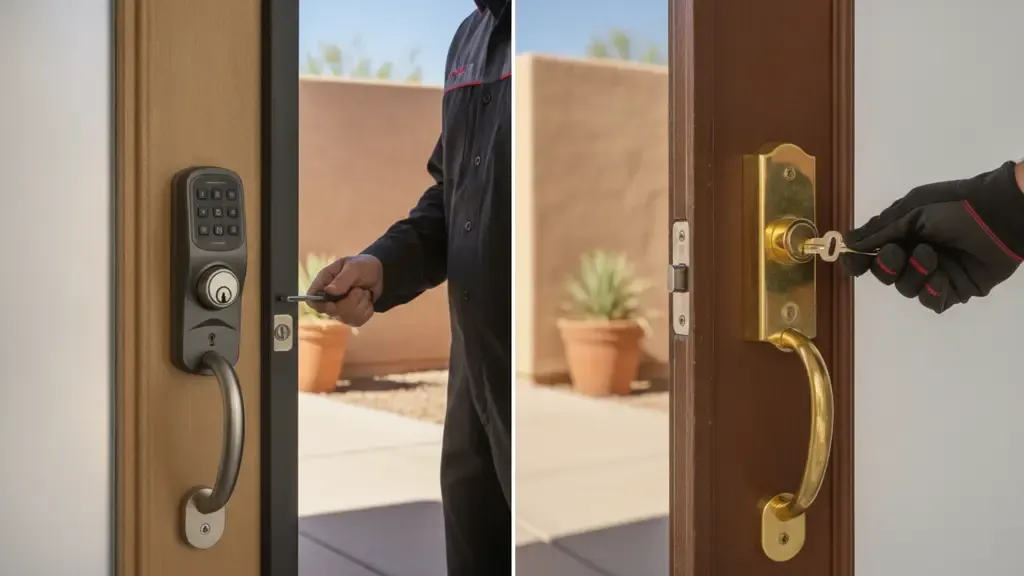
Choosing between electronic door locks and traditional locks is less about following a trend and more about matching the lock to the way a door is used. Electronic locks can offer codes, cards, mobile credentials, or other key-free entry options. Traditional mechanical locks rely on a physical key and a proven mechanical mechanism. For a Mesa homeowner, landlord, or small-business owner, the right choice depends on access control, maintenance, the door itself, and what should happen if a battery or component fails.
Request a lock consultation or installation from The LOCK Shop.
Electronic door locks vs. traditional locks at a glance
Electronic and traditional locks can both secure a properly fitted door. The main difference is how the user is authenticated and how access is managed. An electronic lock verifies a code, card, fob, fingerprint, mobile credential, or another supported input before releasing the latch or deadbolt. A traditional lock verifies the cuts on a physical key.
Neither category is automatically the safest option for every property. A strong lock installed on a weak door frame can still leave an opening vulnerable. An electronic lock with poorly managed codes can create a different kind of risk. A traditional lock with uncontrolled key copies can also be difficult to manage. Think about the complete opening, the people who need access, and the consequences of a lockout before choosing hardware.
| Consideration | Electronic door locks | Traditional mechanical locks |
|---|---|---|
| Primary access | Code, card, fob, fingerprint, mobile credential, or key backup, depending on the model | Physical key, usually with a turnpiece or lever on the inside |
| Access changes | Users or codes may be added, changed, or removed without changing the whole lock, depending on the system | Rekeying or replacing the cylinder changes who can use a key |
| Power needs | Usually batteries or another power source; connected systems may also depend on a network or app | No batteries, network, or software required for normal operation |
| Maintenance focus | Battery checks, credential management, software or app upkeep when applicable, and door alignment | Key condition, cylinder wear, lubrication when appropriate, and alignment |
| Best fit | Homes or businesses that need flexible access and easier user changes | Doors where simple, dependable key operation and low technical complexity matter most |
Bottom line: Electronic locks are usually strongest as an access-management solution, while traditional locks are usually strongest as a simple, power-independent entry solution. A locksmith can help evaluate whether either option fits the door and the way the property operates.
How access methods change the daily experience
The most visible difference is how people enter. With an electronic lock, an owner may create a code for a family member, provide a temporary credential to a guest, or use a card or mobile device if the system supports it. A small business may want to remove a former employee's credential without collecting every key in circulation. The exact options depend on the model, so treat access methods as a selection requirement, not a promise that every electronic lock has every feature.
Traditional locks keep the process familiar. A person uses a physical key, and the owner controls access by deciding who receives a copy. If a key is lost or a tenant, employee, or contractor should no longer have access, the owner may need to rekey or replace the lock. That extra step can be worthwhile when a property has a stable group of users and the owner prefers a straightforward system.
Electronic access can reduce the number of physical keys in circulation, but it creates a new responsibility: credential management. Codes should not be shared casually, former users should be removed promptly, and an owner should know how to use the lock's backup entry method. An electronic lock is not set-and-forget hardware. It is a physical lock with an access-control layer.
Are electronic door locks more secure?
Electronic door locks are not automatically more secure than traditional locks. They can provide useful control features, such as separate credentials for different users, scheduled access on supported systems, or activity records. Those features may improve accountability and make it easier to change access after a move, employee departure, or service visit. They do not replace sound door hardware, a secure frame, correct installation, and responsible access practices.
Where electronic locks can help
- Managing several users: Separate credentials can be easier to control than a growing ring of copied keys.
- Changing access: Supported systems may allow an owner to remove a code or credential without replacing the entire lock.
- Reviewing activity: Some systems record events, which can help a business understand when approved credentials were used.
- Reducing key dependence: Keypad or credential entry can be convenient for people who frequently misplace keys.
Where traditional locks can help
- Keeping the system simple: A mechanical lock does not require batteries, an app, a network, or software updates.
- Maintaining predictable operation: Users who are comfortable with keys may prefer a familiar entry method.
- Serving low-turnover spaces: A home, storage room, or small office with a stable user group may not need electronic credential management.
- Using established locksmith services: Rekeying, repair, and replacement can restore control when key access changes.
For either option, inspect the door and frame as a system. A loose strike plate, damaged jamb, binding deadbolt, exposed hinges, or poor alignment can undermine a good lock. For businesses, the opening may also need to work with egress, accessibility, and fire-safety requirements. Those details are reasons to ask a locksmith to review the installation instead of choosing hardware from a feature list alone.
Maintenance: batteries and credentials versus keys and cylinders
Electronic locks shift some maintenance from metal keys to power and access management. Owners should check the battery status using the method provided by the manufacturer, keep the approved replacement batteries available, and understand the lock's low-power and backup-entry procedure. If the lock connects to an app or access platform, the owner should also keep account access secure and review users periodically.
Do not wait until the door will not open to learn how an electronic lock handles a drained battery. Some models have a mechanical key override, an exterior emergency power contact, or another manufacturer-specific backup. Not every model uses the same method, and forcing the hardware can damage the lock or door. If the backup procedure is unclear, contact the manufacturer or a locksmith before an emergency occurs.
Traditional locks have fewer technical dependencies, but they still need care. A key can bend, wear, or break. A cylinder can become difficult to turn. A door can settle so the bolt rubs against the strike. Adding the wrong lubricant, forcing a stiff key, or repeatedly slamming an out-of-alignment door can make a small problem worse. A locksmith can identify whether the issue is the lock, the door, the frame, or the key.
The maintenance question is not whether one category needs attention. Both do. Electronic locks need power and credential discipline. Traditional locks need key control and mechanical inspection. Choose the type whose maintenance responsibilities fit the people who will manage the property.
Installation considerations that affect the result
A lock replacement is not always a simple matter of removing one unit and attaching another. Before selecting electronic or traditional hardware, check the door thickness, backset, bore dimensions, handing, trim, strike location, and clearance. A replacement also needs to match the way the door closes and the way people use the entry.
Electronic lock installation
Electronic hardware adds questions about battery access, exterior exposure, interior clearance, motor travel, credential setup, and the relationship between the lock and the door frame. If a deadbolt already binds, an electronic motor may struggle with the same alignment problem. If the property needs remote management or business access control, the owner also needs to understand network, account, and user-administration requirements before choosing a system.
For a commercial opening, electronic access may interact with exit hardware, door closers, schedules, and the building's daily operation. The installation must support safe exit and the intended level of control. A business should not choose an electronic product solely because it offers an app or keypad.
Traditional lock installation
Traditional hardware still needs accurate fit and solid installation. The latch or deadbolt should extend cleanly, the strike should be secure, and the door should close without excessive force. If a homeowner wants a different key arrangement, the locksmith may recommend rekeying, a new cylinder, or replacement hardware based on the existing system.
In either case, professional installation is especially useful when the door is damaged, the opening is unusual, the lock is part of a larger access plan, or the owner needs dependable operation for multiple users. Correct installation protects the investment in the hardware and helps avoid a lockout caused by an overlooked fit problem.
See residential lock and keyless-entry services from The LOCK Shop.
Which option fits a home?
Electronic door locks may fit a home where family members, guests, cleaners, caregivers, or short-term visitors need different access arrangements. They can also be helpful when a homeowner wants to enter without carrying a key or wants a way to change access after a move. The owner should still select a model with a clear backup plan and keep the door hardware in good condition.
Traditional locks may fit a home where a small, stable group uses the door and the owner values low technical complexity. A quality mechanical lock can be a sensible choice for a side door, interior utility space, rental property with a straightforward key plan, or any opening where codes and apps would add work instead of removing it.
Many homes use a combination. The front entry may use an electronic lock for convenient family access, while a garage, gate, or less frequently used door uses a traditional lock. The goal is not to make every opening identical. The goal is to give each opening the right level of control and dependable operation.
Which option fits a small business?
Businesses should start with the access problem. If employees change often, several doors need different permission levels, or an owner needs to know which credential was used, electronic access control may be worth evaluating. It can make access changes more organized, but it also requires someone to manage users, power, and the system's administrative settings.
Traditional locks may be a better fit for a small office or storefront with a limited, stable team and no need for activity records. Rekeying can restore control after employee turnover or a lost key. A commercial locksmith can also help coordinate mechanical locks with master key planning, door hardware, and the building's operating requirements.
The LOCK Shop provides commercial locksmith services that include commercial lock changes, rekeying, master key systems, and access control. A business owner can review the commercial locksmith and access-control services before deciding which questions to bring to an on-site assessment.
When should you call a locksmith?
Call a locksmith when you need help selecting, installing, repairing, or regaining control of a lock. Professional help is particularly useful in these situations:
- You are replacing a lock and are unsure whether the new hardware fits the door.
- The deadbolt or latch binds, rubs, or requires force to operate.
- You need to rekey after moving, losing a key, or changing tenants or employees.
- You want electronic access but need to compare local keypad hardware with a larger access-control system.
- An electronic lock has a low battery, failed credential, damaged component, or unclear backup-entry procedure.
- A business door must work with exit hardware, closers, accessibility needs, or a broader master key or access plan.
- You are locked out and want non-destructive entry methods that protect the lock, door, paint, and weather seals.
The LOCK Shop is a family-owned and woman-owned locksmith company based in Mesa, with a storefront for key and lock services and mobile technicians who bring service to customer locations. The company documents residential keyless-entry work and commercial access-control services, along with 24/7 emergency availability and same-day service when applicable. For urgent help, call (480) 452-4505. For planned work, use the Request Service form.
How to decide between electronic and traditional locks
Use this short decision process before buying hardware:
- List the users: Count the people, guests, employees, contractors, or tenants who need access now and may need access later.
- Define the access change: Decide whether you need simple key copies, rekeying, separate codes, temporary credentials, activity records, or scheduled access.
- Check the door: Look for alignment, damage, unusual dimensions, weather exposure, and hardware that already binds or sticks.
- Plan for failure: Know what happens if a key is lost, a battery is low, an app is unavailable, or a credential is rejected.
- Match the maintenance owner: Choose the system the homeowner, property manager, or business administrator can reliably maintain.
- Get an installation review: Ask a qualified locksmith to confirm fit, operation, and the right service path before finalizing the purchase.
Electronic door locks can be a practical upgrade when flexible access matters. Traditional locks can be the better answer when simplicity, power independence, and familiar operation matter more. The best choice is the one that protects the complete door opening and gives the people responsible for the property a system they can use and maintain with confidence.
Contact The LOCK Shop for help choosing or servicing your door locks.